
What Causes Foundation Settlement in Idaho?
Educational guide to foundation settlement causes in Idaho including expansive soils, poor compaction, moisture cycles, erosion, and load concentration.
Soil, Water, and Structural Load Explained
Need a property-specific answer?
We can inspect the issue on-site, document what is actually happening, and tell you whether it needs drainage work, waterproofing, structural repair, or simple monitoring.
- Treasure Valley soil and moisture context
- Photo-documented findings and next steps
- No-pressure recommendations built for your property
Foundation settlement happens when soil beneath a structure compresses, shifts, erodes, or loses bearing capacity over time. In Idaho, settlement is often tied to a combination of soil variability and water variability, which is why the most durable repair plans address both structural support and moisture management together.
What settlement actually means under a home
Homeowners often hear the word settlement and assume it describes one simple event, as if the house merely sank a little because the ground got old. In reality, settlement is a category of structural response. It means the supporting soils under the foundation changed in a way that allowed part of the structure to move. That change may have happened slowly through long-term consolidation, or it may have accelerated because water altered the strength and consistency of the soil in one area more than another.
That distinction matters because the repair depends on the mechanism. If the issue is compressible fill under one section of footing, the correction strategy will look different than if the issue is runoff concentration washing fines away from the support zone. If the movement is being driven by seasonal moisture cycling in clay-sensitive soil, the plan must stabilize both the structure and the moisture conditions that keep reactivating the movement. Idaho settlement problems are rarely solved by a one-dimensional answer.
Settlement is also not evenly distributed. Some structures settle a little over time without meaningful distortion. The concern rises when the support changes are uneven, because then the home begins bending, cracking, and transferring stress in ways finishes and framing were not designed to tolerate. That is why one part of the home may show distress while another appears stable.
Why Idaho homes are vulnerable to settlement
Idaho properties, especially across the Treasure Valley, can sit on a wide range of soils within relatively short distances. One lot may contain stronger native material in one area and looser fill in another. Another may have clay-rich zones that change behavior depending on moisture level. Some neighborhoods include alluvial soils that were deposited over time and do not behave uniformly under load. That variability makes settlement more likely when drainage is poor, irrigation is heavy, or the original subgrade preparation was inconsistent.
Water is the common amplifier. Poorly compacted soil may remain apparently stable until repeated wetting weakens it. Clay may remain manageable until one side of the house experiences different moisture conditions than the other. Fine soils may stay in place until concentrated runoff begins removing support gradually from footing edges or slab margins. That is why Idaho Drainage Solutions treats drainage and settlement as closely related topics. The soil does not fail in isolation from the water reaching it.
Seasonality matters too. Idaho homes experience spring snowmelt, irrigation-season loading, fall transitions, and winter freeze-thaw. Those cycles can repeatedly change the moisture profile around the structure. A homeowner may see the symptoms as random, but the soil is often responding to those seasonal patterns in a very predictable way.
The main settlement mechanisms we see in the field
One major mechanism is poorly compacted fill. If soil placed during construction was not densified adequately, it can continue compressing under the load of the structure long after the home is occupied. That compression may be slow, which is why the most obvious symptoms sometimes show up years later. Another mechanism is moisture-driven volume change. In clay-influenced zones, repeated wetting and drying can create shrink-swell cycles that alter support consistency from season to season.
Erosion and washout are also common, particularly where runoff is concentrated near one part of the home. Water leaving a downspout too close to the foundation, draining along a side yard, or collecting near an outside corner can remove or weaken fine support soils over time. Localized wetting from irrigation is another frequent contributor. When one side of the structure is kept wetter than the rest, the soil under that side behaves differently. Additions, heavy hardscape, or other load concentrations can make the problem worse by stressing already weak subgrade.
Most importantly, these mechanisms can overlap. A lot may have mildly weak fill, but the visible settlement does not appear until drainage failure magnifies the difference. A house may sit on clay-sensitive soil, but the worst movement occurs where roof runoff and negative grade repeatedly load one section. The repair only works when that combined mechanism is understood.
Warning signs that the movement is active
Settlement usually announces itself through pattern, not through one isolated crack. Reappearing cracks after cosmetic repair are a strong clue because they suggest the structure is still moving. Doors and windows that go out of alignment in more than one area, increasing floor slope, or visible separation where walls and ceilings meet are also meaningful because they show distortion rather than simple finish shrinkage. Exterior symptoms such as stair-step cracks in masonry, slab separation, or widening foundation cracks add to the picture.
Seasonal change is another important clue. If cracks widen after wet periods, calm down during drier months, or reopen after snowmelt and irrigation season, the movement may be moisture-coupled. That does not make it temporary. It means the same mechanism is being reactivated over and over again. In Boise and the broader Idaho market, that often points back to grading, runoff control, soil sensitivity, or long-term perimeter wetting.
Homeowners should also pay attention to where the symptoms cluster. When cracking, sticking doors, and floor irregularities all occur on the same side of the house or near the same corner, that concentration often reveals where support conditions have changed most. Settlement is a structural pattern, and patterns are what good inspections interpret.
How a correct diagnosis is built
The first step is understanding whether the movement is uniform, differential, old, or active. That requires reviewing crack direction and progression, floor and wall behavior, and the layout of the distress across the structure. The second step is reviewing the site itself. Does the home have poor grade? Are downspouts discharging near footing lines? Is there evidence of prolonged wetting, irrigation oversaturation, or runoff concentration? Has the yard been modified in ways that changed how water moves across the property? Without that site review, the structural diagnosis is incomplete.
This is also why online advice often falls short. Two homes can show a similar crack pattern for completely different reasons. One may need deeper support such as push piers or helical piers. Another may need drainage correction and monitoring because the movement is early-stage and moisture-driven. Another may need both. The point of a professional review is to determine which mechanism is primary and which supporting corrections are required to keep the repair durable.
Homeowners can improve the process by documenting when symptoms appeared, whether they change with weather or irrigation, and what prior repairs have already been attempted. That history often reveals whether the movement is ongoing and what conditions are most likely to be driving it.
What effective settlement repair usually includes
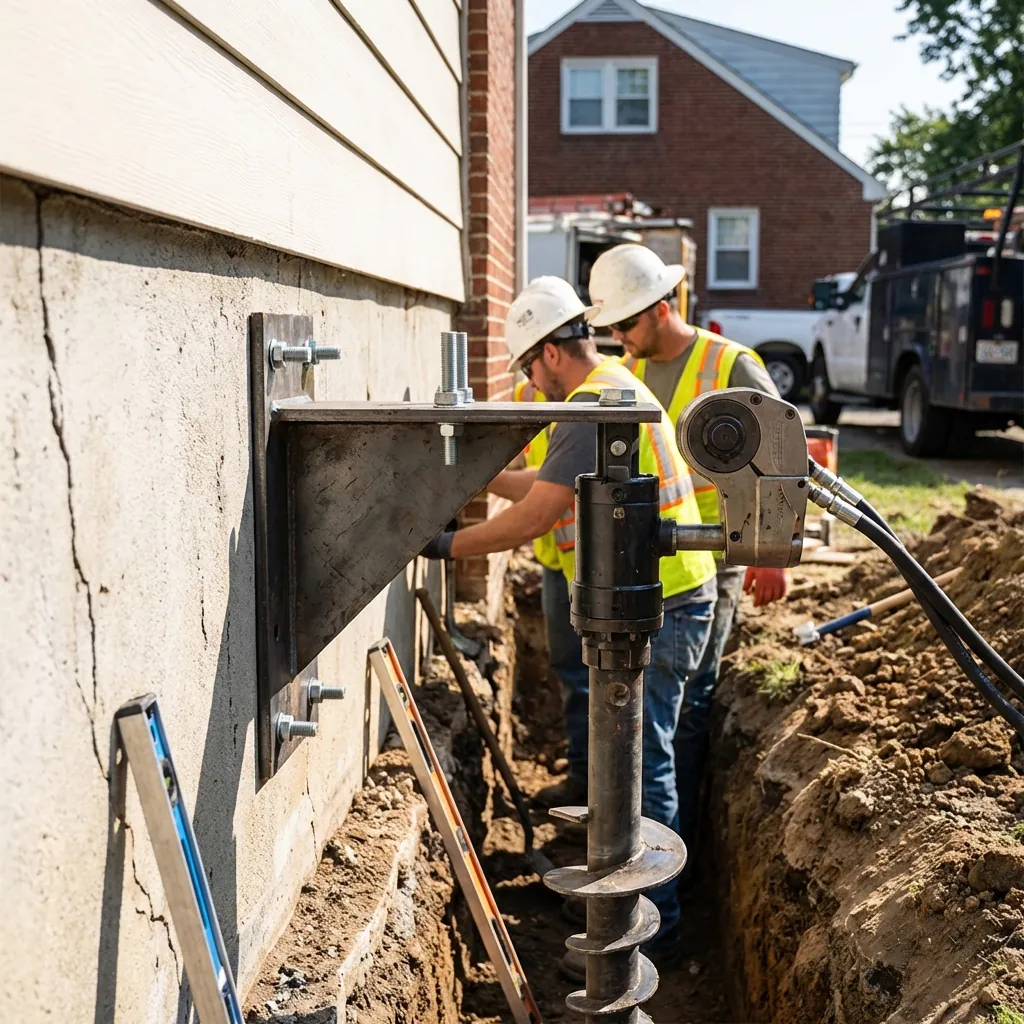
The right repair nearly always has two tracks. The first is structural stabilization where needed. If a footing has lost support, the structure may need a transfer path to deeper or more reliable bearing through systems such as piers. The second is moisture management. If water is still concentrating around the home, then even a strong structural repair is being left in a stressed environment. Idaho Drainage Solutions therefore evaluates both the support method and the drainage environment at the same time.
In practice, that often means combining structural support with drainage planning, grade correction, roof runoff rerouting, and discharge improvements. In some cases, the drainage work is what prevents the problem from spreading to additional sections of the foundation. In others, it is what protects the performance of the structural repair that was already necessary. Either way, settlement that is tied to water should not be approached as a concrete-only problem.
Repair planning should also include verification. Once the work is complete, the question becomes whether the system is actually behaving better over time. Monitoring crack stability, confirming dry perimeter behavior, and maintaining drainage components are part of preserving the result.
How Idaho homeowners can reduce future risk
Not every settlement problem can be prevented, but many can be reduced by stabilizing moisture conditions around the house. That means keeping roof runoff away from footings, avoiding chronic overwatering near the foundation, maintaining positive grade, and correcting recurring yard flooding before it becomes a structural issue. It also means paying attention when the house begins sending early signals instead of assuming cracks are purely cosmetic.
Reference sources such as the USDA Web Soil Survey, USGS water resources, and NOAA climate data can help homeowners understand the bigger context of soil and moisture conditions in Idaho. But the decision about your home should always come back to what your structure and your lot are doing specifically.
When homeowners understand the real cause of settlement, they stop chasing symptoms and start protecting the structure. That shift in thinking is what turns a worrying crack pattern into a clear repair strategy.
Common decision errors that make settlement more expensive
The most expensive settlement decisions are usually not the repairs themselves. They are the delays and half-measures that let the underlying mechanism continue working. Homeowners often repaint cracks, replace doors, or re-level portions of a floor before the support and drainage conditions have been diagnosed. Those steps may improve appearance temporarily, but they do not stop a footing from losing support or a wet perimeter from stressing the same side of the home again.
Another common error is separating structural repair from water management as if the two have nothing to do with each other. In Idaho, they often do. A home that receives pier support but keeps a chronic runoff concentration near the foundation is still living in a high-risk moisture environment. The best outcomes usually come from sequencing the work correctly: identify the movement mechanism, stabilize what needs stabilization, and correct the water conditions that were helping drive the movement in the first place.
What a strong settlement evaluation should deliver
A good settlement evaluation should do more than confirm that movement exists. It should explain where the movement is concentrated, what the likely support mechanism is, how moisture is influencing the structure, and what sequence of corrections makes the most sense. Homeowners should come away understanding which risks are immediate, which can be monitored, and how the repair scope protects both the structure and the budget.
That level of clarity is what keeps settlement repair from becoming guesswork. When the evaluation identifies both the structural path and the water path, the homeowner can compare proposals intelligently and avoid spending money on steps that improve appearance without improving performance.
In practical terms, a strong evaluation should leave the homeowner with a clear explanation of cause, consequence, and next step. That clarity is what turns a worrying pattern of cracks or slope changes into a repair strategy that is both technically sound and financially responsible.
It should also clarify whether the home is best served by monitoring, drainage correction, structural stabilization, or a staged approach that protects the highest-risk area first. That kind of prioritization is what makes complex settlement problems manageable.
When that level of explanation is missing, homeowners are often left comparing prices without ever really understanding the scope. When it is present, they can make a repair decision based on engineering logic instead of uncertainty.
That is ultimately what good settlement guidance should provide: a disciplined path from symptom to cause to action.
Without that path, homeowners are left with isolated recommendations instead of a real repair strategy.
Get a Settlement Cause Analysis
We’ll identify the likely movement mechanism and build a repair plan that addresses both structure and water conditions.
Common Failure Signs in Idaho
Water Intrusion
Moisture seeping through walls, floors, or foundation during rain or irrigation season.
Structural Warning Signs
Cracks in walls, sticking doors, or uneven floors indicating foundation movement.
Ongoing Maintenance Issues
Recurring problems that never seem to go away despite multiple repair attempts.
Serving All of Idaho & The Valley
Our structural specialists are in Idaho daily.
Idaho Settlement Causes FAQ
Can settlement stop on its own?
Should I fix drainage before structural work?
How do you confirm settlement versus cosmetic cracking?
What Idaho Homeowners Say
"They explained why our foundation was settling and gave a clear action plan."
"Great technical explanation and professional execution."
"They addressed both structural support and drainage, and the results have held."
Why Homeowners Use Idaho Drainage Solutions
Licensed & Insured
Fully licensed in Idaho (RCE-57554) with comprehensive liability coverage for your protection.
Prompt Scheduling
We respect your time. Appointments scheduled within 24-48 hours for most estimates and inspections.
Satisfaction Guaranteed
We stand behind our work with industry-leading warranties and a commitment to getting it right.
Local Expertise
We know Treasure Valley soil, water tables, and building codes better than anyone.
No-Surprise Pricing
Clear, upfront quotes with no hidden fees. The price we quote is the price you pay.
Free Consultations
Every project starts with a free on-site evaluation. No pressure, just honest advice.

0% Interest Financing Available
Flexible payment options for your drainage projects.
Related Next Steps in Idaho
Need help applying this to your property?
If this settlement causes sounds familiar at your home, we can inspect the property and give you a clear scope.